What Are the Top Lighting Showrooms for Global Buyers?

Choosing a Lighting Showroom is more than comparing polished displays. Global buyers need a place where product quality, technical details, and practical support meet. A striking pendant may catch the eye, but beam angle, color temperature, dimming compatibility, and material finish can determine whether it suits a real project. Details matter.

The strongest showrooms make evaluation easier. Buyers can compare fixtures under different lighting conditions, inspect metal and glass finishes, and ask for clear specifications. Useful staff should explain installation needs without overstating performance. For international projects, also check product documentation, packing standards, lead times, and whether the supplier can support sample requests. These details can prevent costly surprises later.

There is no single showroom that fits every buyer. A hotel designer may prioritize custom finishes and project coordination, while a distributor may focus on stable stock and consistent product data. A beautiful display is helpful, but it cannot replace verified specifications or careful follow-up. Samples can look different under office lights than they do in a finished room. That deserves a second look. This guide explores what global buyers should assess when comparing leading lighting showrooms, from product range and expertise to communication and delivery support. The goal is not to praise every polished space, but to identify the signs of a dependable sourcing partner—and the questions worth asking before placing an order.
What Are the Top Lighting Showrooms for Global Buyers?

How Lighting Showrooms Differ by Format, Product Range, and Buyer Services

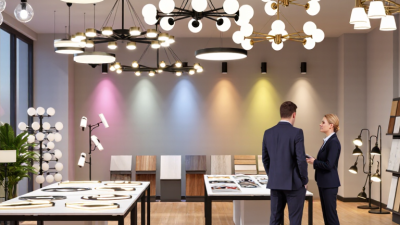
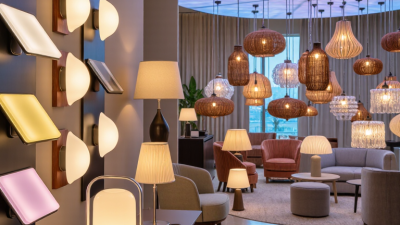
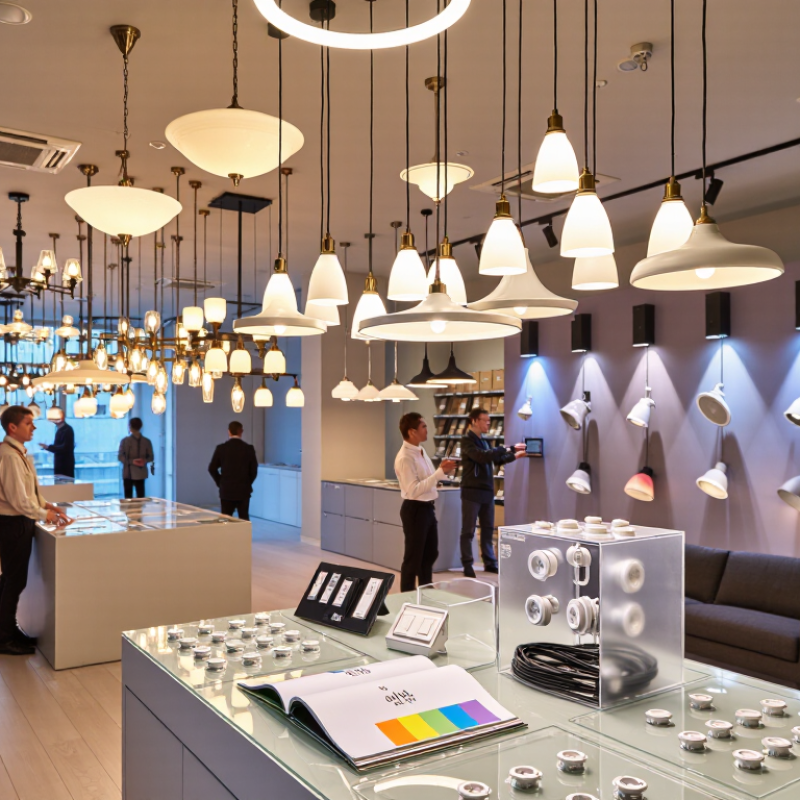
Lighting showrooms vary less by size than by how they help buyers make decisions. Large design centers let visitors compare decorative fixtures, finishes, and light output in room-like settings. Technical studios focus on beam angles, controls, and photometric data; trade counters prioritize stock visibility and quick quotations. Online catalogs help shortlist products, but a screen cannot show glare on a polished stone surface. That matters.

Product range is another dividing line. Some showrooms carry lamps, architectural fixtures, outdoor products, and control systems under one roof. Others specialize, offering deeper technical support for fewer categories. The U.S. Department of Energy’s 2020 Lighting Market Characterization estimated that LEDs accounted for 48% of installed lighting stock in the United States. Buyers should therefore check whether a showroom provides current efficacy, color temperature, and compatibility details—not just attractive displays.

Buyer services can include sample loans, project takeoffs, technical consultations, and coordinated delivery. The DOE notes that residential LEDs use at least 75% less energy than incandescent lighting, but savings depend on the application and usage pattern. Ask for written specifications and a clear replacement policy. Then test samples in the actual space. Showroom comparisons are imperfect; display lighting can flatter a fixture more than a real ceiling will.

Where Global Buyers Find Major Showroom Hubs Across China, Europe, and North America

China’s showroom network is concentrated around manufacturing and trade hubs. In Guzhen, near Zhongshan, buyers can compare rows of pendant lights, outdoor fixtures, and ceiling systems within a compact area. Guangzhou offers broader sourcing and export services, while Shenzhen showrooms often highlight connected controls and contemporary designs. Bring a short specification sheet. Ask to see color temperature, dimming behavior, driver details, and finish samples under neutral light. A polished display does not guarantee consistent production; that distinction is easy to miss.

In Europe, Milan is a useful stop for decorative and design-led lighting, while Frankfurt’s trade environment leans toward technical and commercial applications. Showrooms may present full-scale installations, making beam spread and glare easier to judge than in a catalogue. Still, regional availability and lead times can differ. Verify them.

North American buyers often visit design centers and trade-show districts in cities such as Dallas, Las Vegas, and New York. These hubs help compare products suited to offices, hotels, and residential projects. Check local electrical requirements, shipping terms, and replacement-part support before placing an order. A showroom visit can clarify a lot, but it rarely answers everything. I would leave time for follow-up questions; I have seen key details surface only after the first comparison.

Compare LED Displays Against the U.S. DOE’s 75% Energy-Saving Benchmark

A lighting showroom should make energy claims easy to verify. The U.S. Department of Energy’s 75% benchmark refers to LED lighting using at least 75% less energy than comparable incandescent lighting. It is a useful reference, not a guarantee for every fixture or installation. Ask what technology and output the comparison uses.

For a fair check, compare fixtures that deliver similar light levels, measured in lumens, and note each model’s wattage. A 10-watt LED replacing a 40-watt incandescent uses 75% less power under that simple comparison. Real results depend on operating hours, dimming, driver quality, and the room itself. Look at the product label. Request test data.

Global buyers should also examine beam angle, color temperature, glare, and local power compatibility. A bright display can look impressive, yet perform poorly in a shop or office. Ask the showroom to demonstrate fixtures on the same surface and settings. Then estimate annual energy use from wattage and expected daily hours. The math is not perfect; occupancy patterns change, and installation conditions are easy to overlook. That deserves a second check.

What Are the Top Lighting Showrooms for Global Buyers?

Compare LED lighting with the U.S. DOE’s 75% energy-saving benchmark

The U.S. Department of Energy states that LEDs use at least 75% less energy than incandescent lighting. This indexed comparison sets incandescent lighting at 100; the LED benchmark is 25 or less. Actual energy use varies by product, so buyers should compare specifications for equivalent light output.

Assess Technical Specifications: Lumens, Efficacy, CRI, CCT, and LM-80

For global buyers, a lighting showroom should make technical comparisons easy, not just display attractive fixtures. Check delivered lumens, the measured light output, and efficacy in lumens per watt. A high lumen figure alone can mislead; a wide beam may look dimmer on a work surface than a focused beam. Ask for photometric files and test conditions.

The U.S. Department of Energy reports that LEDs use at least 75% less energy than incandescent lighting. That benchmark is useful, but it does not replace fixture-level efficacy data. Compare products at similar output, beam angle, and dimming level. Then inspect CRI and CCT: CRI helps describe color rendering, while CCT indicates whether light appears warm or cool. Neither tells the whole story. A fabric sample can look different under showroom lighting than beside a window.

For lifetime claims, request LM-80 test reports for the LED packages, modules, or arrays. ANSI/IES LM-80 measures lumen and color maintenance over time; it does not certify the complete luminaire’s lifespan. DOE guidance also distinguishes measured results from projections made using TM-21. Check the tested temperature and operating hours. Paperwork can be dense. I would still question a lifetime claim without its test conditions, even when the showroom sample looks excellent.

What Are the Top Lighting Showrooms for Global Buyers? - Assess Technical Specifications: Lumens, Efficacy, CRI, CCT, and LM-80

Specification Indicative reference points What buyers should verify in a showroom
Luminous flux (lumens) Example product ranges: LED downlights commonly provide about 600–1,200 lm; LED high-bay luminaires often provide about 15,000–30,000 lm. Actual needs depend on the application and optical design. Request rated luminaire output, not just LED-chip output. Check the test conditions and photometric report, and compare products designed for the same use.
Luminous efficacy (lm/W) Many general-purpose integrated LED luminaires fall roughly within 80–120 lm/W. Efficacy varies with output, optics, color quality, driver, and operating conditions. Confirm the figure is for the complete luminaire: delivered lumens divided by input watts. Compare like-for-like products at the same CCT, CRI, and output level.
Color rendering (CRI) CRI (Ra) ≥80 is a common baseline for general indoor lighting; ≥90 is often selected where more faithful color appearance is important, such as retail displays or art areas. Ask for measured test data and the specific CRI rating. For color-critical applications, also request relevant color-quality information, such as R9, and assess samples under the intended lighting conditions.
Correlated color temperature (CCT) Common nominal choices include 2700 K, 3000 K, 3500 K, 4000 K, and 5000 K. Lower values appear warmer; higher values appear cooler. Check the stated CCT and permitted tolerance, and view samples together. Ask whether the same fixture is available in the required CCT and whether it can be tuned.
LM-80 and lumen maintenance LM-80 reports lumen-maintenance testing for LED packages, arrays, or modules under specified conditions; tests commonly cover at least 6,000 hours. It does not, by itself, establish whole-luminaire lifetime. Request the LM-80 report for the LED component used and check the tested drive current and temperature. Review any TM-21 projection separately; it is an estimate based on LM-80 data, not a direct lifetime test of the complete luminaire.
Photometric distribution Beam angle and intensity distribution depend on the fixture and optics; there is no single suitable value for every room or task. Request an IES or equivalent photometric file and a lighting calculation for the project. Check mounting height, spacing, target illuminance, and glare control.
Dimming and controls Compatibility depends on the luminaire, driver, control protocol, and dimmer. A dimming claim alone does not guarantee flicker-free or smooth performance. Confirm the control method, compatible equipment, dimming range, and behavior at low levels. Test the proposed combination before ordering.
Global documentation Applicable requirements vary by destination market, product type, and installation. Test reports and certificates should match the exact product configuration. Ask for current market-specific compliance documents, product datasheets, warranty terms, and sample availability. Verify document scope, ratings, and model details before purchase.

Note: The figures above are indicative screening references, not rankings or specifications for any particular showroom or product. Confirm project requirements and obtain product-specific test documentation before making comparisons.

Verify Export Readiness Through IEC Standards, CE Marking, UL Listings, and IP Ratings

An export-ready lighting showroom should make compliance easy to inspect, not merely display attractive fixtures. Ask staff to match each product code with its technical documents and market-specific approvals. Check the nameplate, driver label, and packaging against the paperwork. Small details matter.

IEC standards define technical requirements and test methods; they are not, by themselves, a universal certificate. For luminaires, request the applicable IEC standard numbers and complete test reports for the exact model. CE marking indicates a manufacturer’s declaration of conformity with relevant EU requirements. Ask to see the supporting declaration and confirm that its model numbers match the products on display. CE is not a general quality grade.

UL Listings can support acceptance in markets where buyers or authorities require them, but verify the listing’s scope and product category. IP ratings describe protection against solid objects and water under specified tests. An IP rating alone does not establish suitability for every outdoor condition. Paperwork can look tidy; the sample may still disappoint. Compare finishes, seals, and cable entries in person, then check whether the tested configuration matches what will ship. A careful showroom should answer these questions without pressure.